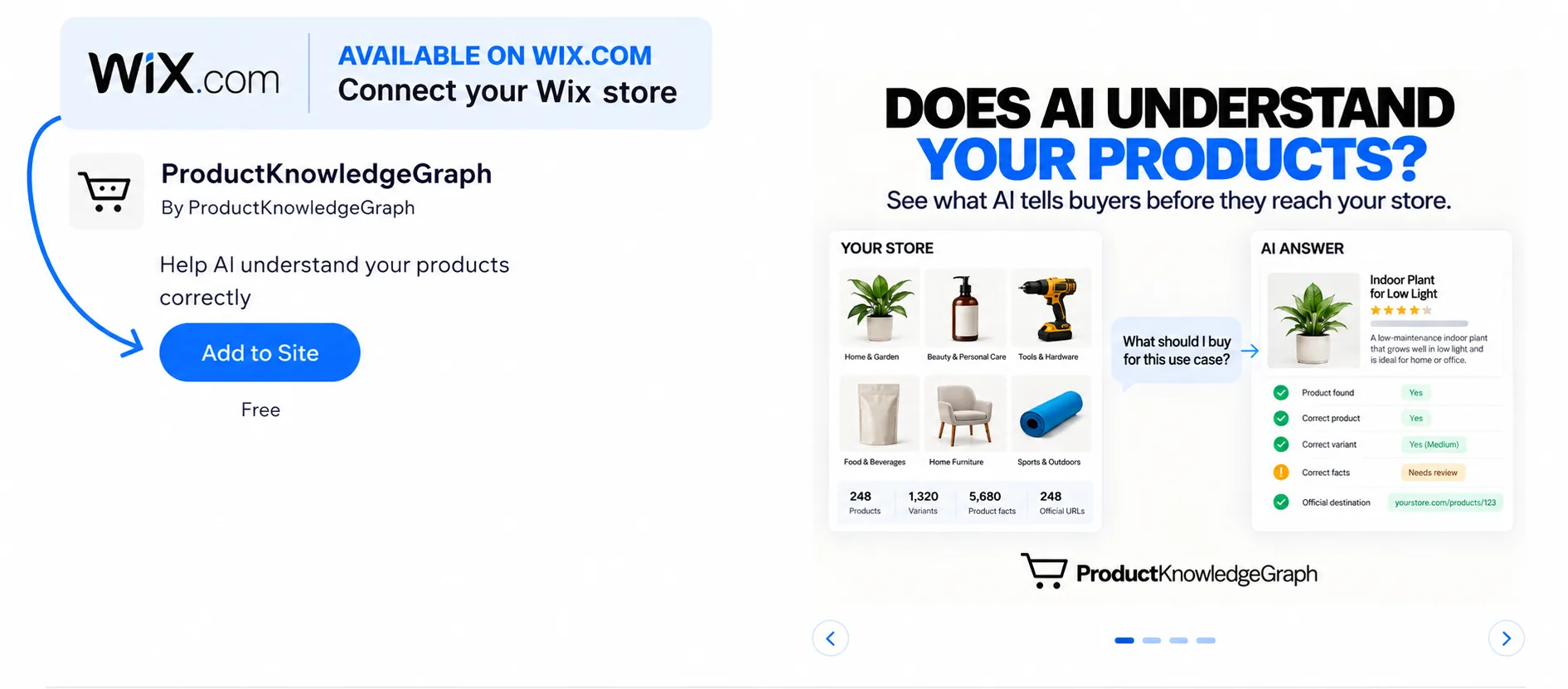
A recent Wix implementation exposed an important problem for merchants preparing for AI-mediated shopping.
At first, the task appeared straightforward: connect the merchant’s existing Wix catalog to ProductKnowledgeGraph, establish the official product data, and test how AI systems represent those products when buyers ask what to buy.
Once we started working with the real merchant data, it became clear that the product catalog was only half of the problem.
We needed two separate but connected truth layers:
AuthorityPrompt for Company Truth and ProductKnowledgeGraph for Product Truth.
This is why.
The buyer may never start on your Wix store
A traditional ecommerce journey often assumes:
Search → Website → Product Page → PurchaseAI changes that sequence.
A buyer can now start with questions such as:
- What is the best product for my use case?
- How much does this product cost?
- What is the warranty?
- Which product is better?
- What alternatives should I consider?
- Where should I buy it?
The first comparison may therefore happen before the buyer reaches the merchant’s website.
That creates a different problem for Wix merchants.
It is no longer enough to ask:
“Is my product page online?”
We also need to ask:
“When AI participates in the buying decision, does it understand the merchant, the product, the correct facts and the official destination?”
We started with the existing Wix data
We did not want the merchant to rebuild an existing catalog inside another system.
The implementation started from the merchant’s existing Wix website and official product pages.
The workflow discovered the website structure, sitemap, structured Product data and individual product URLs. Those existing product pages could then become the starting point for establishing authoritative product information.
This is an important principle of the Wix integration:
the merchant should not have to maintain a second manual catalog simply to become AI-ready.
ProductKnowledgeGraph connects the existing commerce data to a separate verification and measurement workflow.
But that immediately revealed another issue.
AI needs to understand more than the product
Imagine that an AI system correctly retrieves a product page.
That does not necessarily mean it understands the business behind that product.
A merchant may have multiple brands, product lines, services, sales models or ways customers can buy. Some offerings may be standard ecommerce products. Others may require configuration, customization, quotation or another purchase path.
The Wix catalog can describe products.
It cannot, by itself, establish every authoritative fact about the company behind those products.
That is why this implementation required a second layer.
Layer 1: AuthorityPrompt — Company Truth
AuthorityPrompt handles the company-level problem.
Its role is to establish the official facts the business approves about itself:
Who is the company? What does it actually do? What does it sell? Which business lines or brands belong to it? Which claims are official? Which sources support those claims?
This matters because an AI system can find an individual product while still misunderstanding the company selling it.
For example, AI might understand one visible portion of a merchant’s website while missing other commercially important parts of the business.
So the first layer establishes:
COMPANY → OFFICIAL FACTS → AUTHORITATIVE SOURCES → AI REPRESENTATIONWe call this Company Truth.
The objective is not to guarantee what an independent AI model will say. It is to create a clear, source-backed company layer and provide evidence that can be compared with what AI actually represents.
Layer 2: ProductKnowledgeGraph — Product Truth
The second layer starts where the company layer ends.
ProductKnowledgeGraph works with what the merchant actually sells.
For a Wix merchant, that can include:
- products and variants;
- official product names;
- prices and other product facts;
- product relationships;
- official product URLs;
- authoritative product sources;
- purchase destinations;
- buyer questions;
- competing alternatives;
- use cases.
This becomes Product Truth.
The important distinction is that ProductKnowledgeGraph does not merely ask whether a product exists somewhere in an AI response.
We want to observe the complete buying context.
Four questions emerged from the real implementation
Working with the merchant’s submitted buyer questions and success criteria produced a much clearer way to think about AI shopping.
Before a purchase, an AI system may need to answer four fundamentally different questions.
1. Can the buyer find the product?
This is discovery.
Does the merchant or product participate in the AI-mediated buying decision at all?
2. Is it the right product for the buyer?
This is consideration and comparison.
How does AI handle questions such as “best product for this use case” or “product A vs. product B”?
3. Are the product facts correct?
This is Product Truth.
Price, warranty, specifications, variants and other product information can materially affect the buyer’s decision.
4. Where does AI send the buyer?
This is purchase destination.
A product being mentioned does not necessarily mean the buyer is sent to the merchant’s official product page.
That last distinction became especially important in this implementation.
Product visibility and purchase destination are not the same measurement.
A merchant can appear in an AI answer and still lose control of the next step in the buyer journey.
We don’t assume the AI problem. We measure it.
There is an important boundary in this work.
Connecting a Wix catalog does not prove that AI is currently getting the merchant’s products wrong.
We do not assume that a competitor is winning.
We do not assume that AI is reporting an incorrect price.
We do not assume that the merchant is losing sales.
And we do not claim that publishing structured information will force an AI provider to change its answers.
Those are questions for evidence.
The workflow therefore becomes:
Official company facts → Official product facts → Frozen buyer questions → AI baseline → Evidence → Controlled corrections → Repeat measurementThis distinction matters.
A merchant should be able to see what was actually observed rather than receive another generic “AI visibility” score accompanied by assumptions about lost revenue.
The Wix connection changes how we can do this
Previously, onboarding a merchant could require significant manual work just to establish what products exist and which source should be treated as official.
With Wix connected, the process can begin from the merchant’s existing commerce infrastructure.
The intended workflow is:
Wix Store ↓ Existing Product Data ↓ ProductKnowledgeGraph ↓ Product Truth ↓ Buyer Questions ↓ AI Baseline ↓ EvidenceIn parallel:
Business Website + Approved Company Information ↓ AuthorityPrompt ↓ Company Truth ↓ AI RepresentationThe two layers then meet at the actual buyer decision:
WHO IS THIS COMPANY?AuthorityPrompt
WHAT DOES IT SELL?
ProductKnowledgeGraph
↓
WHAT DOES AI TELL THE BUYER?
This was the key lesson from the implementation.
For many merchants, Company Truth and Product Truth cannot be treated as the same problem.
Why this matters beyond one merchant
The architecture is not tied to one product category or one type of seller.
A Wix merchant may sell apparel, electronics, cosmetics, furniture, sporting goods, automotive products, specialty equipment or almost anything else.
The individual buyer questions will change.
The underlying problem does not.
A buyer asks AI for help making a decision.
The merchant needs to know:
- Did my product enter the decision?
- Did AI identify the correct product and variant?
- Did it preserve the official facts?
- What alternatives did it present?
- Did it use the official source?
- Where did it send the buyer next?
Those are measurable questions.
And they are becoming part of ecommerce infrastructure.
Connect an existing Wix store
Wix merchants can now connect their existing store to the ProductKnowledgeGraph workflow rather than manually recreating their catalog for AI testing.
The connection is designed to start from the merchant’s existing product information and official product pages. From there, ProductKnowledgeGraph can establish the product layer required for Product Truth, buyer-question testing and evidence.
Connect your Wix store to ProductKnowledgeGraph →The objective is not to replace Wix.
It is to add something ecommerce platforms were not originally designed to provide:
a way to establish what is officially true about a merchant and its products, and then measure whether that truth survives when AI participates in the buying decision.