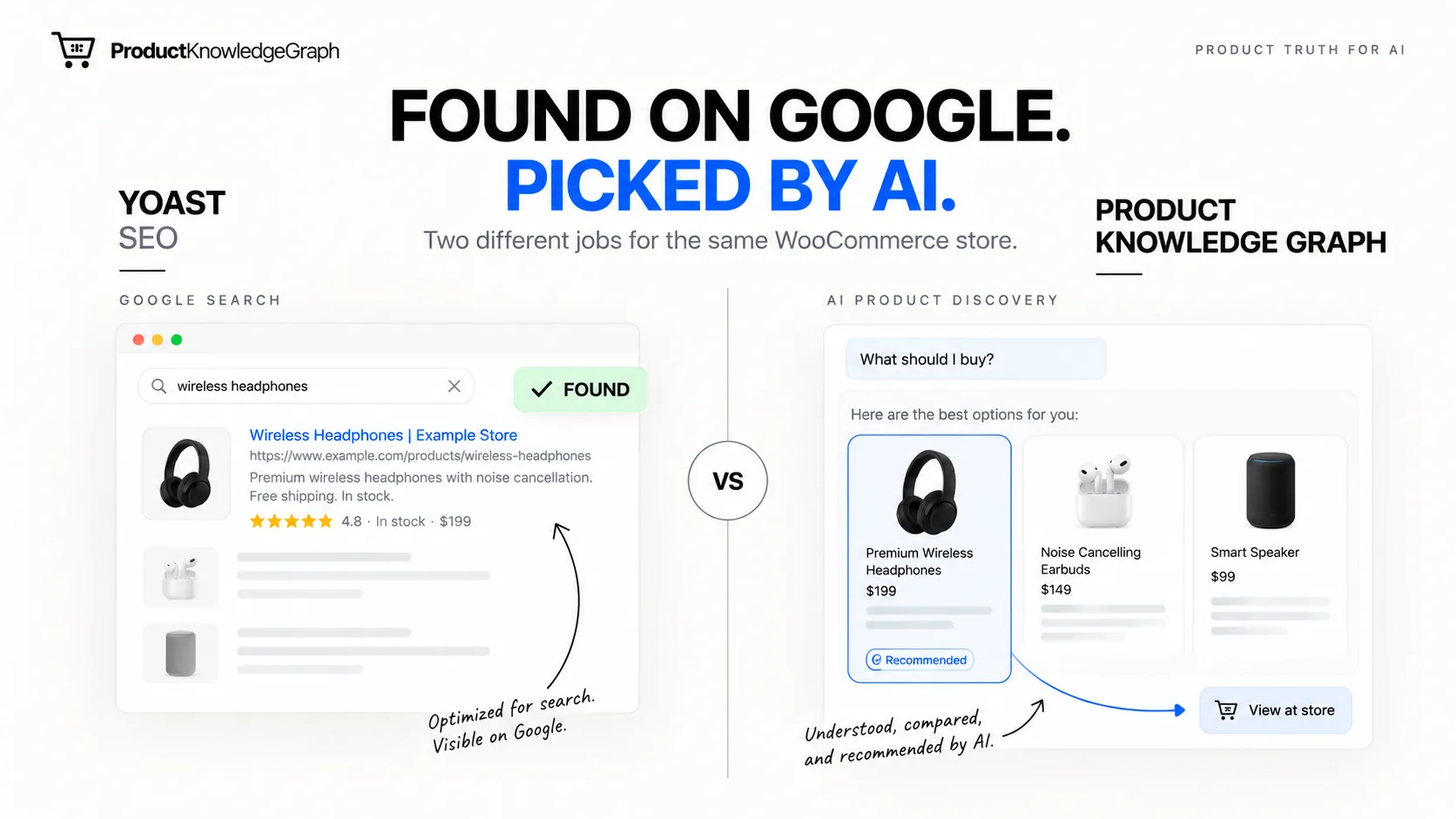
If you already use Yoast WooCommerce SEO, should you replace it with ProductKnowledgeGraph?
No.
Yoast WooCommerce SEO and ProductKnowledgeGraph solve different problems.
Yoast WooCommerce SEO helps search engines understand your store and helps your products perform in traditional search.
ProductKnowledgeGraph helps answer a different question: when a buyer asks AI what to buy, does AI show your product, understand it correctly, and send the buyer to your store?
For many WooCommerce stores, the two can be used together.
Disclosure: We build ProductKnowledgeGraph. This comparison is based on publicly documented Yoast features as of September 25, 2026. Yoast is an established SEO product, and ProductKnowledgeGraph is not intended to replace it.The buying journey is changing
For years, the typical ecommerce discovery journey looked something like this:
Google search → search results → product page → purchase
That journey still matters.
But there is now another path:
Buyer question → AI answer → product recommendation → product link → store
A shopper can ask:
- “What is the best portable espresso machine for travel?”
- “Which air purifier is quiet enough for a small bedroom?”
- “Which replacement part works with this model?”
- “What is the best option under $300?”
ChatGPT, Gemini, Perplexity and other AI systems can research products, compare alternatives and return a short list before the buyer ever visits a merchant’s website.
For the store owner, that creates a new set of questions:
- Did AI show my product?
- Did it recommend my product or a competitor?
- Did it understand the correct model, variant, compatibility, price or use case?
- And when it mentioned my product, did it link to my store — or somewhere else?
Those are not traditional ranking questions.
They are AI product discovery questions.
This distinction is central to ProductKnowledgeGraph: presence, recommendation, accuracy, fit, differentiation and destination are measured separately rather than collapsed into a single “AI visibility score.”
⸻What Yoast WooCommerce SEO does
Yoast WooCommerce SEO is built primarily around ecommerce SEO.
At the time of writing, Yoast lists the package at $178.80 per year excluding VAT. It includes WooCommerce-specific SEO functionality together with Yoast SEO Premium and other premium Yoast products.
For a WooCommerce store, that includes useful capabilities such as:
- Product structured data. Yoast can expose price, availability, ratings, identifiers and other product information through Schema markup.
- Product identifiers. It supports GTIN8, GTIN12/UPC, GTIN13/EAN, GTIN14, ISBN and MPN, including identifiers for product variants. Yoast can also warn when identifiers are missing.
- Product sitemaps. It keeps pages such as cart, checkout and account pages out of product-oriented XML sitemaps and includes product gallery images.
- AI-assisted SEO writing. Yoast WooCommerce SEO includes AI generation for product titles and meta descriptions.
- Redirect management and traditional SEO tooling. URL changes, search previews, writing assistance and other Yoast Premium functionality are included.
These are useful jobs.
If organic Google traffic matters to your store, there is no reason to stop doing them simply because AI shopping is growing.
⸻Yoast also has AI features
This distinction matters because it would be inaccurate to say that Yoast does nothing for AI.
Yoast currently offers several AI-related capabilities.
llms.txt
Yoast can automatically generate an llms.txt file intended to make important site content easier for AI systems to discover and understand. Yoast lists this functionality across its plans, including WooCommerce SEO.
AI-generated content
WooCommerce SEO can use AI to generate and optimize product-related SEO content.
AI Brand Insights
Yoast also offers AI Brand Insights, which examines brand visibility, questions, sentiment, citations and competitors across AI platforms.
However, Yoast’s own plan comparison currently lists AI Brand Insights under Yoast SEO AI+ rather than Yoast WooCommerce SEO.
This is where the distinction with ProductKnowledgeGraph becomes important.
ProductKnowledgeGraph is not primarily asking:
“Does AI mention my brand?”
It asks:
“When a buyer asks what to buy, what product does AI choose?”
And then:
“If it shows mine, is the product understood correctly and where is the buyer sent?”⸻
AI can know your product and still send the sale somewhere else
This is one of the most important differences between traditional SEO visibility and AI-mediated product discovery.
Imagine two WooCommerce stores.
We’ll call them Store 1 and Store 2.
We run three realistic buyer questions for products sold by each store across multiple AI providers with web search enabled.
The purpose is not to ask:
“Tell me about Store 1.”
The brand is deliberately absent from the buyer question.
Instead we ask questions such as:
“What espresso machine should I buy for a small home kitchen?”
or:
“Which grill is best for someone who wants easy temperature control?”
That recreates a much more commercially relevant situation: the buyer knows what they need, but has not chosen the brand yet.
Suppose the observation looks like this:
| Store 1 | Store 2 | |
|---|---|---|
| AI answers observed | 6 | 6 |
| Product/brand appeared | 3 | 2 |
| Answer linked to merchant’s own site | 0 | 1 |
| Other destinations | resellers, reviews | competitors, reviews |
The first number looks encouraging.
AI knows Store 1.
It even mentions its products in half of the observed answers.
But commercially, something important happened:
none of those answers sent the buyer to Store 1’s own website.
The product received visibility.
The merchant did not receive the destination.
That is why ProductKnowledgeGraph separates being mentioned from being recommended, and separates both from getting the correct official destination.
The ProductKnowledgeGraph strategy explicitly treats those as different stages: a product being named is not the same as being recommended, a recommendation is not a click, and a click is not a purchase.
⸻What this looks like to a WooCommerce merchant
A merchant usually does not experience this as an “AI optimization” problem.
They experience things like:
“AI recommends my competitor.”
Your product exists. Google indexes it. Your SEO may be perfectly respectable.
But when the buyer asks for the use case, AI chooses another product.
“AI knows my product, but sends buyers to a reseller.”
This is particularly deceptive.
From a brand-visibility perspective, the answer looks successful.
Your product was mentioned.
From the merchant’s perspective, the customer may have been handed to somebody else.
“AI describes the wrong variant.”
The buyer needs one size, compatibility or configuration.
The AI combines facts from different variants or cannot determine which variant fits.
“AI doesn’t understand what my product is actually good for.”
Your product page might say:
“Premium quality. Innovative design. Industry-leading performance.”
A buyer asks:
“Will this work in a 150-square-foot bedroom?”
The page may be excellent marketing copy while still failing to provide the exact fact needed to answer that question.
“I fixed the product page. Did it change anything?”
This is another difference.
Changing a page is not evidence that an AI answer changed.
You have to ask the same buyer question again and compare the observation.
And sometimes the correct result is:
No change yet.
ProductKnowledgeGraph’s strategy explicitly requires that state rather than manufacturing a success story when the evidence does not support one.
⸻Why good WooCommerce SEO may not answer this
SEO remains important.
AI systems can use web search and product data when producing answers, so clean pages, identifiers, structured information and crawlability can all contribute to machine understanding.
But the optimization target is different.
Yoast’s product is designed around helping search engines understand and surface your ecommerce pages.
ProductKnowledgeGraph starts with the buyer’s product question.
That creates several differences.
1. A Google ranking doesn’t tell you which product AI selected
A store can rank well and still be absent from an AI recommendation.
Conversely, AI may mention a product that is not the first traditional organic result.
The measurement therefore has to happen in the AI answer itself.
⸻2. Product identity becomes especially important
Yoast already supports product identifiers and correctly emphasizes their value for search engines.
They also matter in AI commerce.
OpenAI’s current product-feed specification supports GTIN and MPN and represents purchasable variants individually, with variant grouping and variant attributes where applicable.
That means a merchant should not think only:
“Does this page have schema?”
They should also ask:
“Can the system identify the exact product and exact variant?”⸻
3. A mention is not a recommendation
An AI response can mention five products and recommend one.
Those are different observations.
ProductKnowledgeGraph therefore distinguishes whether the product was:
not shown → shown → understood correctly → recommended → linked to the correct destination.
We do not convert all of those into one “AI score.”
⸻4. A recommendation can still send the buyer somewhere else
This is the problem that is easy to miss.
AI may correctly recommend your product and then cite or link:
- Amazon;
- a reseller;
- a marketplace;
- a review site;
- an obsolete product page;
- or even a competitor’s site elsewhere in the answer.
For the merchant, destination matters.
⸻5. Changing information isn’t enough — you have to measure again
ProductKnowledgeGraph uses a simple cycle:
Find → Understand → Fix → Measure.First, ask the buyer’s question.
Then compare what AI said with authoritative product information.
If there is enough evidence to identify something that can be corrected, prepare that correction.
Then ask the same question again.
The result may be:
Improved.
Or:
No change.
That distinction matters because a before/after observation alone does not prove that a specific change caused a sale or even caused the AI response to change.
ProductKnowledgeGraph deliberately keeps those evidence levels separate.
⸻What ProductKnowledgeGraph does
ProductKnowledgeGraph is designed around AI-mediated product decisions.
For a WooCommerce merchant, the workflow is:
1. Find
Ask AI systems the questions buyers actually ask.
See whether your product appears, which competing products appear, and where the answer directs the buyer.
2. Understand
Compare the AI observation with official product information.
- Is the variant wrong?
- Is compatibility unclear?
- Is a product fact outdated?
- Is the official purchase destination missing?
- Did AI choose another product?
Where the evidence is insufficient to explain why, ProductKnowledgeGraph should say so rather than invent a cause.
3. Fix
Where there is a supported correction, ProductKnowledgeGraph prepares the change.
The merchant remains in control where approval is required.
4. Measure
Repeat the same buyer question and compare the result.
- Did the product appear?
- Was the correct product understood?
- Was it recommended?
- Did the answer contain the official destination?
Those are separate observations.
This is the Buyer Check model at the center of ProductKnowledgeGraph.
⸻ProductKnowledgeGraph for WooCommerce
There is now a free ProductKnowledgeGraph plugin in the official WordPress Plugin Directory:
Install ProductKnowledgeGraph for WooCommerce on WordPress.orgThe connector links a WooCommerce store to ProductKnowledgeGraph’s official product records.
Today the plugin provides, among other things:
- AI Publication Status and AI Product Coverage inside WordPress;
- product-level Published / Not published status;
- matching of official product records using SKU or GTIN;
- an official product-feed connection;
- an optional Share catalogue action;
- a server-side product reference without loading external JavaScript on product pages.
Importantly, the plugin’s published WordPress.org description says it does not read orders, customers or payments, does not load external JavaScript, and does not change the visible page content. The optional catalogue-sharing action requires an explicit click.
So this is not a replacement for WooCommerce.
And it is not a replacement for Yoast.
It connects the merchant’s existing WooCommerce catalog to the ProductKnowledgeGraph product-truth and AI-discovery workflow.
⸻Yoast WooCommerce SEO vs ProductKnowledgeGraph
| Question | Yoast WooCommerce SEO | ProductKnowledgeGraph |
|---|---|---|
| Primary job | Ecommerce SEO and search visibility | AI-mediated product discovery |
| Helps Google understand products | Yes | Not its primary job |
| Product Schema | Yes | Uses official product records/connectors for its own product-truth workflow |
| GTIN / MPN support | Yes | Uses product identity such as SKU/GTIN to connect WooCommerce products with official records |
| SEO titles & meta descriptions | Yes | No |
| XML sitemap optimization | Yes | No |
| Redirect management | Yes | No |
| llms.txt | Yes | Not the core mechanism |
| AI brand monitoring | Available through separate Yoast SEO AI+ | Product-level Buyer Checks are the focus |
| Asks unbranded buyer product questions | Not the core WooCommerce SEO workflow | Yes |
| Shows whether AI selects your product or alternatives | Not the core WooCommerce SEO workflow | Yes |
| Checks product accuracy against product truth | Not its primary job | Yes |
| Checks official purchase destination in AI answers | Not its primary job | Yes |
| Prepares supported corrections | SEO/content optimization | Yes, within the PKG remediation workflow |
| Repeats the same buyer question after a change | Not the core workflow | Yes |
| Guarantees AI recommendation or sales | No | No |
The most important row is the first one.
These products are solving different problems.
⸻Should you replace Yoast with ProductKnowledgeGraph?
No.
If Yoast WooCommerce SEO is working for your store, keep it.
Google search still matters.
Product schema still matters.
Product identifiers still matter.
Sitemaps, redirects, titles and descriptions still matter.
ProductKnowledgeGraph addresses the next question:
What happens after the buyer stops searching for a page and starts asking AI what to buy?A WooCommerce merchant can therefore use:
Yoast WooCommerce SEO for search.
and
ProductKnowledgeGraph for AI-mediated product discovery and product decisions.
The two are complementary rather than mutually exclusive.
⸻One thing every WooCommerce store should check today
Regardless of which plugin you use, check your product identity data.
For products that have assigned identifiers, make sure the correct GTIN, UPC/EAN or manufacturer part number is attached to the correct product and variant.
Yoast itself recommends accurate product identifiers because they help Google distinguish products and variants. OpenAI’s current product-feed specification likewise uses identifiers and explicit variant data in its commerce product model.
Do not invent identifiers for products that do not have them.
Good product identity helps machines establish which exact thing they are looking at.
That is useful for both traditional ecommerce search and AI commerce.
⸻The question SEO doesn’t answer
For years, ecommerce teams have asked:
“Where does my product rank?”
That question still matters.
But there is now another one:
“When my customer asks AI what to buy, does it pick my product or my competitor?”
And if AI does pick your product:
“Does it understand the right product — and does it send the buyer to me?”
That is the problem ProductKnowledgeGraph is built to measure.
Already using Yoast WooCommerce SEO? Keep it. Then run a ProductKnowledgeGraph Buyer Check to see what happens in the AI buying journey that starts before the customer reaches your store.
Install the free ProductKnowledgeGraph WooCommerce plugin on WordPress.org